
Chipped, Cracked or Broken Tooth? Here’s What to Do.
Crunching on ice, popcorn or hard candy, or taking a fall, can leave you with a chipped tooth, a cracked tooth or a broken tooth. Rinse with warm water and save any pieces in a little milk, because they can sometimes be put back on. We keep time open every weekday for emergencies, and if you need a crown (a cap that covers a damaged tooth), it can often be designed and printed here in our office lab. Call or text (252) 478-3422 and we’ll do our best to see you the same day.
Written by the Spring Hope Family Dentistry team and reviewed by Dr. Elie Abboud, DDS, based on guidance from the American Association of Endodontists, Cleveland Clinic, MedlinePlus and the NHS.
What to Do Right Now for a Chipped or Broken Tooth
Find what matches your tooth below, then call or text us, even if it doesn’t hurt much. Cracks don’t always hurt.
If a piece broke off
- Rinse your mouth gently with warm water.
- If it’s bleeding, press clean gauze on the spot for about 10 minutes.
- Hold a cold compress on your cheek or lip, over the broken tooth.
- Find the piece and keep it in milk. No milk? Spit into a cup and keep it in your saliva. Bring it with you.
- Call or text us. A broken piece can sometimes be put back on.
If there’s a sharp or jagged edge
- Cover it with orthodontic wax (the soft wax made for braces) or a small piece of sugar-free gum, so it doesn’t cut your tongue or cheek.
- Stick to soft foods and chew on the other side.
- For soreness, take ibuprofen or acetaminophen as the label directs.
- Call us to have it repaired. Wax and gum only cover the edge until we can fix it.
If it hurts with air or cold drinks
Bite gently on a piece of moist gauze to cover the tooth, and skip very hot and very cold foods and drinks for now.
A quick twinge usually means the break has uncovered the softer layer under the enamel, and it still needs covering soon. Pain from hot or cold that lingers for more than 30 seconds can mean the nerve (the soft, living tissue in the center of the tooth) is damaged, so call us the same day.
Can it wait? A small chip that doesn’t hurt can wait a little, but it should still be fixed. A large break, a tooth that hurts, or a badly cracked tooth is an emergency, so call or text us right away. Not sure which one you have? Text us what happened.
Lost a filling or crown rather than part of the tooth? See what to do about a lost filling or crown.
What Not to Do
A few very normal reactions do more harm than good with a broken tooth. Skip these.
- Don’t put gels, ointments or aspirin on it. Numbing gels, ointments and aspirin don’t belong on an injured tooth. Aspirin, any other painkiller or clove oil held against the gum can burn it.
- Don’t chew on it. Biting down makes the pieces of a cracked tooth move, and that irritates the nerve. Chew on the other side until it’s fixed.
- Don’t assume no pain means no problem. Cracks don’t always hurt, and a crack won’t heal on its own.
- Don’t wait on a large or painful break. A badly cracked tooth is an emergency, so call us the same day.
- Be careful with medicine for kids. Don’t give aspirin to anyone under 16 unless their doctor says to. Use a children’s pain reliever dosed by age and weight, as the label directs. Numbing gels are out at any age after an injury, and benzocaine gels should never be used on a child under 2.
- Don’t treat a loose or knocked-out tooth like a chip. Those need different first aid, and a knocked-out adult tooth is time-critical. Follow our knocked-out or loose tooth steps instead.
ER, Urgent Care or Dentist?
Go to the emergency room, or call 911, if:
- Your teeth won’t close together the way they normally do, or you think your jaw may be broken
- You think you’ve broken a bone in your face
- The bleeding won’t stop with firm pressure
- You blacked out, even for a moment, or you have a bad headache, confusion, vomiting or trouble staying awake after a fall or a hit to the head
- You’re having trouble breathing, swallowing or speaking, or you’re drooling
- Swelling is spreading toward your eye, down your neck or under your jaw or tongue, or your face is so swollen you can’t open your mouth
- You have a fever of 100.4°F or higher along with a swollen face
- Jaw pain comes with chest discomfort, shortness of breath or light-headedness. Call 911, because that can be a heart attack.
If you’re that hurt or that sick, don’t drive yourself. Have someone take you, or call 911.
For everything else, call a dentist first. Emergency rooms and urgent care clinics can give you medicine for the pain, but they don’t do fillings or crowns, so they can’t repair the tooth.
If an adult tooth was knocked out completely, every minute counts. Put it back in the socket right away if you can, and follow our knocked-out tooth steps.
After hours or on a weekend? Text us at (252) 478-3422 and we’ll get back to you as soon as we’re open: Monday 7:30 to 4:30, Tuesday and Wednesday 7:30 to 5:30, and Thursday and Friday 7:30 to 3:30. Until then, follow the first steps at the top of this page. If your face is swelling or you have a fever and you can’t reach us, go to the ER. If it’s pain that medicine isn’t helping, urgent care or the ER can help until we open. If you have any of the warning signs above, go to the nearest emergency room or call 911.
Chip, Crack or Break: How Serious Is It?
A small chip is usually the simplest fix. With a crack, the right fix depends on where it runs and how deep it goes. Here are the main types of cracked teeth and what each one usually needs.
| What happened to the tooth | Typical fix |
|---|---|
| Tiny lines in the enamel, the hard outer layer of the toothCraze lines | No treatment needed |
| A corner of the chewing surface breaks offFractured cusp | A filling or a crown |
| A crack that reaches the nerve in the center of the toothCracked tooth, into the pulp | A root canal, then a crown |
| A crack that runs below the gumlineCracked tooth, below the gumline | The tooth can’t be saved and needs to come out |
| A tooth cracked into two separate partsSplit tooth | It can’t be saved in one piece. Depending on where the split runs, part of it can sometimes be kept |
| A crack that starts down in the rootVertical root fracture | Usually taking the tooth out, or sometimes surgery |
Source: American Association of Endodontists, Cracked Teeth.
How We Repair a Broken Tooth
Every break is a little different, but a visit for a broken or cracked tooth here usually goes like this. If you’re nervous, we offer laughing gas (nitrous oxide) and oral sedation, a calming medicine you take by mouth.
- 1
We find the break and where it runs
We check the tooth a few ways: a bite test (you bite on a small tool so we can find the spot that hurts), magnification and a bright light, a dye that makes a crack easier to see, a thin probe and X-rays. When it helps, our 3D cone beam (CBCT) scan shows the tooth, root and bone around it in three dimensions.
- 2
Small chips: bonding or a filling
A small chip is often fixed with bonding, a tooth-colored filling material we shape to match the rest of your tooth. If you saved the piece, we’ll see if it can go back on.
- 3
Bigger breaks: a crown, often made in our own lab
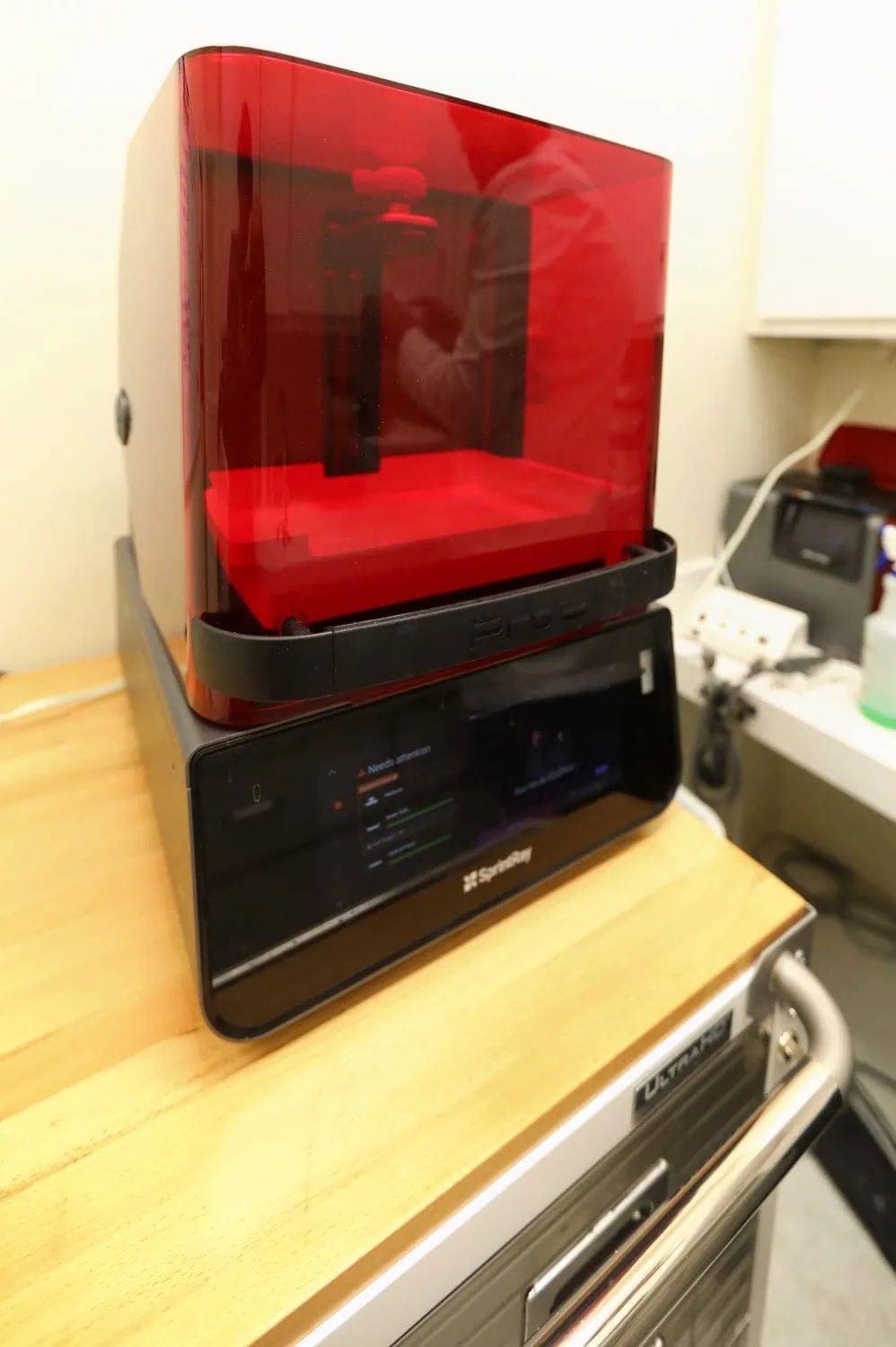
When a bigger piece breaks off, or a corner of the chewing surface cracks away, a crown covers the tooth and protects what’s left. Crowns can often be designed and printed here in our office lab, on a 3D printer that’s FDA-cleared for permanent crowns.
- 4
A crack into the nerve: a root canal, then a crown
If the break or crack reaches the nerve, the tooth usually needs a root canal, which cleans out the damaged nerve inside the tooth, followed by a crown. In a child or teen whose tooth is still growing, a smaller treatment that keeps the nerve alive is sometimes enough. Dr. Abboud and Dr. Hilary both do root canals, molars included, and most are done right here in our office. A root canal usually takes one or two visits, and it’s no more painful than a filling.
- 5
If it can’t be saved: we take it out and plan what’s next
A crack below the gumline means the tooth has to come out, and so do many split teeth and root fractures. We usually do extractions right here in the office, then talk through your options for filling the gap, like a single-tooth implant (a replacement root topped with a crown) or a bridge (a false tooth held in place by the teeth on either side).
Want to see what a repair can look like? See a real case on our emergency page.
Cracked Tooth Syndrome: Pain When You Let Go
Some cracked teeth never lose a piece at all. What you notice instead is pain with a pattern to it, which dentists call cracked tooth syndrome. It hurts because the cracked pieces move when you bite, and that irritates the nerve inside.
Signs to watch for:
- Sharp pain that comes and goes when you chew
- Pain when you let go after biting down
- Sensitivity to hot or cold that comes and goes
Sharp pain on biting can also come from a cavity or a loose filling, so it’s better to have it checked than to guess. If your pain is more of a steady ache, our toothache guide covers other causes and what helps.
Cracks are more likely if you:
- Are 50 or older
- Chew ice, popcorn or hard candy
- Have large fillings
- Grind your teeth
- Have had an injury to your mouth
Can a cracked tooth heal? No. Most cracked teeth that get treated go on to give years of comfortable chewing, but some cracks keep growing even after treatment, and the tooth can still be lost. Treating it early gives it the best chance. If the crack came from an injury, like a fall or a hit to the mouth, have the tooth checked at your regular visits for up to 5 years, even once it feels fine.
Frequently Asked Questions
Is a broken tooth an emergency, or can it wait?
It depends on the size of the break and whether it hurts. A large or painful break, or a badly cracked tooth, is an emergency, so call or text us the same day. A small chip that doesn’t hurt can wait a little, but it should still be fixed.
Can a cracked tooth heal on its own?
No. A crack won’t heal, and cracks don’t always hurt, so a tooth that feels fine can still need care. Treatment helps, though: most cracked teeth that get treated give years of comfortable chewing, even if some cracks keep growing after treatment.
Why does my tooth hurt when I stop biting?
Pain when you let go after biting is one of the signs of a cracked tooth. When you bite, the cracked pieces move and irritate the nerve inside the tooth. Sharp pain on biting can also mean a cavity or a loose filling, so have it checked soon.
Will I need a root canal for a cracked tooth?
Only if the crack or break reaches the nerve. If it does, the usual fix is a root canal followed by a crown, and most are done right here in our office. Other breaks usually need a filling or a crown.
When does a cracked tooth have to come out?
When the crack runs below the gumline, when the tooth has split into separate parts, and often when the root itself is cracked. In those cases the tooth usually can’t be saved. Most extractions are done right here in our office, and we’ll go over your options for replacing the tooth first.
Can the broken piece be glued back on?
Sometimes, by your dentist. Keep the piece in a little milk. If there’s no milk, spit into a cup and keep it in your saliva. Bring it with you. Don’t try to glue it back yourself. If it can’t be reattached, bonding or a crown can rebuild the tooth.
Can I fix a chipped tooth at home?
You can protect it, but you can’t repair it at home. Orthodontic wax or sugar-free gum over a sharp edge, soft foods and pain relief as the label directs will help until we see you. A crack won’t heal on its own, so the tooth still needs a dentist.
What can I take for broken tooth pain?
Ibuprofen or acetaminophen, taken as the label directs. For adults and teens 12 and older, the American Dental Association lists anti-inflammatory pain relievers like ibuprofen as the first choice for dental pain. Ask a pharmacist or your dentist before taking the two together. Check with your doctor before taking ibuprofen if you take blood thinners, have had stomach ulcers or bleeding, a heart attack or a stroke, or have heart or kidney disease or asthma. If you’re pregnant or have liver disease, ask your doctor before taking either one. With acetaminophen, use only one product that contains it at a time, and don’t take it if you have three or more alcoholic drinks a day. For children, use a children’s product dosed by age and weight, and don’t give aspirin to anyone under 16 unless their doctor says to.
What does it cost to fix a broken tooth?
A small chip is usually a simple fix, and a crown or root canal costs more. For new patients, the emergency exam and X-ray is $99, and VIP Plan members get one emergency exam a year included. If you need treatment, you’ll get the exact price in writing before we start, and we’ll file your insurance for you. Payment plans are available through Cherry, Sunbit and CareCredit.
Do I have to be a patient of yours to be seen?
No. Call or text (252) 478-3422, tell us what happened, and we’ll do our best to see you the same day. Calling or texting first is the fastest way in. If you walk in, we’ll fit you in as the day allows. We see broken teeth from Spring Hope, Nashville, Rocky Mount, Wilson and the towns around them.
Broken Tooth Repair for Spring Hope and Nearby Towns
We see tooth injuries from Spring Hope, Nashville (about 10 minutes), Rocky Mount (about 15), Wilson (about 20), Zebulon, Bailey and Middlesex, Bunn, Louisburg, Castalia, Elm City and Lake Royale. Call ahead and we’ll have a room ready.
Broke a Tooth? Call Us First.
We keep time open every weekday for emergencies, and we’ll do our best to see you the same day.